Friday, June 3, 2016

Patrick Gower Plays Fantasy Cabinet Football. Loses. - A Response From An NZ First Perspective


Way back towards the start of the year, when questions about what role NZ First might potentially play in and around government post-2017 started to be asked internally, I proposed to my comrades the idea of playing what we termed 'fantasy Cabinet football' to try and work out what the shape of an NZ First party in Government might look like.

We batted around a few ideas, but ultimately put the notion on the backburner, as it appeared a hugely complex piece of prognostication whose accuracy would be contingent upon so many factors (including the likely shape of NZF's 2017 Parliamentary List) which were simply unknowable or hadn't been decided yet.

In other words, we chose wisdom over speculation and restraint over rampant excitability.

Predictably, however, Newshub's Patrick Gower shares neither of those virtues; and has generated his own exercise in fantasy Cabinet football ministerial portfolio allocations for a hypothetical NZ First-Labour-Greens government.

Upon first setting eyes on his list, I had but two questions:

First, who on EARTH did he "interview" to get this information - and second, how over the top and absurdist was their sense of humour.

Because seriously. The list he's prepared is, in many ways, a joke - with the inclusion of Shane Jones, let alone Shane Jones rather above Ron Mark as one of its multifarious misfiring punchlines.

We were all (perhaps somewhat irrationally) expecting better from Gower's noted correspondent and inside source, Mr M.Y. Keyboard. Less charitable interpretations might suggest the misinformation in question flowed forth from his close relationship with Mr M.Yass.

But while it's easy to criticize and castigate (fun, too!), it's inestimably harder to actually construct something of worth and value. Particularly in the fraught and effervescent field of political analysis.

So in a spirit of showing Gower where he went wrong, here's a cursory critique and reworking of his Fantasy Cabinet Football team.

The first point of forehead-vein-twitching is whom he's included in the team-pool. Obviously, there are no major issues with Winston, Ron Mark, or Fletcher Tabuteau being listed as prime candidates for Cabinet Ministerial positions. Each are hugely competent MPs in complete command of their portfolios and demonstrably positive records in both Parliament and the Parliamentary legislative process. Two of this number - Winston and Ron - have even been Ministers before, while Fletcher's strong private members' bills this term have shown a clear strength at identifying issues in his portfolio areas - before they become issues - and coming up with creative, innovative solutions with which to tackle them.

As much as I might have crossed swords (and an array of other, slightly more painful implements of dentistry) with Tracey Martin over the last two years, she is also an arguably competent inclusion at the Ministerial level - and has seriously positive relationships with many of the sector and interest groups within her portfolio areas. Her wide array of positive relationships with non-NZF MPs are also a plus, and nobody doubts her often absolutely frenetic work-ethic. When I was working under her for Parliamentary Services during the last Parliamentary term, I was continually impressed by her command of both policy and legislative detail as well as elements of vision in her portfolio areas. There are clearly many worse choices one could make for a spot in Cabinet.

As applies Clayton Mitchell, due to his private sector background there is a logical role for him as a Minister for Small Business. His personal interests and aptitudes might also make him a good fit for Minister for Sport and Recreation.

And now, for the others whom Gower's occasionally inexplicably listed.

First up, what on earth is Shane Jones doing there. He's not part of our Party, and as far as I can tell, rumours of his return have been several shades of conspiracy from various different largely self-interested sources attempting to plant 'words in your ear' with pliant and pliable media mouthpieces. While I can't with iron-clad assurance say "it's not going to happen" ... I *can* say that there's no verifiable information out there which would have allowed Gower to make such an incendiary prediction with any shred of objectively factual basis. This is even leaving aside whether you'd WANT such a proverbial 'loose cannon' as Jones running the arguably rather delicate Foreign Affairs portfolio in the first place.

About the nicest thing I can possibly say about this "prediction" is that it's a pretty passable troll-attempt from Gower to suggest that the TPPA-promoting Jones ought to be included not only in our Party - but at its highest echelons, and a few notches up from our evident leadership heir apparent, Ron Mark. Certainly got MY choler rising, at any rate.

Second, Stuart Nash. While there have been some rumours around Nash's defection as an attempt to go from 'in the red' to 'in the black' previously, I'm unsure how concrete any of the information behind them might actually be. Certainly, in some areas the occasionally somewhat outspoken Nash does align towards NZF over the direction of the previous five years of Labour - but smaller scale disagreements of policy and emphasis of direction do not a defection make. Gower doesn't seem to be particularly sure either - hence why he's posted a "watch this space' next to Nash's party membership in this whole contrivance.

Third, Ria Bond. By all accounts, she's improved rather markedly over her year or so in Parliament - although while meaning no disrespect to her, I would question whether somebody who'd have been an MP for a mere two years by the time this hypothetical 2017 Government got off the ground, would truly be ready for the weighty responsibilities of a Ministerial role. Then again, several of the NZF MPs cited in both Gower's and my own projections have only been in Parliament for a year longer - so perhaps I am being unduly harsh. It would be considerably easier to adjudge her suitability or otherwise if Gower had thought to include *which* Ministerial portfolio she was supposed to be taking up outside of Cabinet. But he hasn't, so I have to wonder whether Gower's sighted future talent in Ria - or whether he's merely indulged in plucking names at random out of a hat to make up numbers.

What was outright curious, however, were some of the omissions.

Darroch Ball has been an absolutely stellar performer in the Social Development portfolio already this term - with visionary legislative proposals, and such an adroit command of the detail in his area that he's managed to force Minister of Social Development Anne Tolley to apologize to the House for misleading with misinformation on quite a number of occasions. Darroch has also recognized and made use of the natural synergies between the Social Development and Youth Affairs portfolios to deliver strong policy for change inestimably superior to pretty much anything the actual Minister's come out with. He is somebody whom I'd absolutely back to the hilt for a Ministerial warrant and Cabinet position, and his lack of inclusion on a list of NZ First ministerial prospects is absolutely criminal.

Another thing which leaped out at me about Gower's Fantasy Cabinet Football lineup was just how ... white-and-Maori it was. With the sole exception of Labour's Carmel Sepuloni (whom Gower's tipped for Pasifika Affairs), there was nobody in there with a migrant-community background. Instead, Tracey Martin was put forward for the Ethnic Affairs role. And while Tracey's work with the Shakti Trust has been admirable and shows an ability to interface with communities and backgrounds not her own ... there seemed to be another, far more obvious candidate in the form of NZ First's Mahesh Bindra. Who, apart from meeting the minimum standard of actually being from one of the communities covered by the portfolio (and therefore better able to relate to and represent the concerns of same), is also - as applies the Indian community at least - in a word, ubiquitous. Seriously. Every Mandir [Hindu Temple] I go to, they know Mahesh. If you follow him on social media, you'll see that literally all his spare time outside of Parliament is taken up with engaging with this community, occasionally clocking up four or five or more events per day. He is quite simply the hardest-working MP outside of Parliament in this area I think I've ever seen. His pre-Parliamentary background in Corrections gives him a strong insight into that portfolio as well, and would make him a natural pick for an (Associate) Minister role there too.

Ultimately, there are many NZ First MPs whose competencies have been ignored in Gower's piece - and I only have space to directly address a few of them.

But the other major issue with this list of hypothetical ministerial allocations are some of the ... curious mismatches of talents and aptitudes with portfolios.

Several of Gower's picks are half decent. Winston Peters' staked Ministerial responsibilities make decent sense, allowing him to build upon career-defining strengths in regional development, immigration, racing, senior citizens, foreign affairs and Pacific relations. Ron Mark is a natural fit for Defence , and given his strong record against Amalgamation as well as direct experience in the area as Mayor of Carterton - could also pick up Local Government (although I'm left scratching my head slightly about him running the Christchurch Regeneration portfolio - it's not that Ron can't do it ... if he can build things in Oman, then Canterbury should present no trouble. I just find it a little inexplicable that a Christchurch-based MP like Labour's Megan Woods wouldn't be given the role).

And, in a hypothetical, totally imaginary world wherein Shane Jones becomes an NZ First MP and Minister, I could well see the logic of handing him a Fisheries portfolio. Tracey Martin's ardent feminism - while a bit of an acquired taste in some circles - would certainly contribute to a strong Minister for Women's Affairs; although some might question whether a single term as a Local Board Member is the best qualification for a position overseeing the Local Government portfolio - particularly when NZ First's Denis O'Rourke has fifteen years' experience as a Christchurch City Councillor to draw upon.

Matters arguably worsen when we see whom Gower's plonked in Primary Industries - Fletcher Tabuteau.
While nobody denies that Primary Industries is an important portfolio for New Zealand's present and future export growth and development, the plain fact of the matter is that it would be a questionable use of Fletcher's considerable talents as both an MP and a former academic/economist. A position such as Trade would be a much more logical fit, particularly considering the excellent private members' bills he's put forward in this area. His strong background and longstanding involvement in both tourism and education (secondary and tertiary) would also suggest potential Ministerial competencies in those areas.

All in all, Gower's attempt at playing Fantasy Cabinet Football is ... not even an especially competently written fantasy. The level of seriousness with which it ought to be taken is clearly elucidated by the fact it's littered with obvious attempted-witticisms like referring to David Cunliffe as "Under-Secretary to the Co-Vice-Deputy Prime Ministers on miscellaneous issues".

And yet, whether born out of ignorance, laziness, or actual malevolence, the greatest jokes in the piece appear to be the arguably unintentional ones. Things like omitting some of NZ First's best and brightest new MPs in favour of making a stirring troll-point by including Shane Jones on a pedestal.

Some might argue that such an obviously highly speculative if not outright onanistic piece of pay-by-the-word political "journalism" hardly merits a response.

And yet going off the numerous ranks of my friends and associates on social media and elsewhere who've either taken this piece at face value as a potential shape for a hypothetical post-2017 NZF/Greens/Labour government ... or who, despite recognizing its shortcomings, still believe there's a few grains of truth in it here and there ... we are left with little choice other than to seek in some small way to correct its more manifestly misaimed assertions.

The trouble with vacuums, in both nature as in politics (which can often be decidedly unnatural), is that they have a nasty habit of being filled. Whether you want them to be or not.

By refusing - thus far, at any rate - to put forward any serious speculation or projections as to who might do what in a Black/Red/Green alliance, we have thus consciously invited figures such as Patrick Gower to cast their own stones and assertions into the void and play some level of role in shaping the public's perceptions of what this prospective future government might look like and function.

About the only positive to be said for Gower's piece (other than the fact that it will help boost name-recognition for some of our MPs and get people used to thinking of them rightly as Ministerial-caliber), is that it has kicked off dozens of discussions on a more serious level about who and what might actually do the heavy lifting in a three-way coalition partnership.


Wednesday, June 1, 2016

The Labour-Greens Agreement - Reactions From An NZ First Perspective


Unquestionably the biggest political news of this week was the joint announcement by Labour and the Greens of a 'Memorandum of Understanding' to take them through to the next Election.

This is a pretty impressive impact given it's merely codifying in the form of a single A-4 sheet of paper something that's basically been an accepted fact of political reality for easily the best part of a decade.

We've all known that Labour and The Greens have to work together in order to change the government since pretty much as soon as the dust cleared following the 2008 General Election. They even tried (rather cackhandedly) a similar pre-electoral accommodation heading into 2014. There's very little that's new here (except a certain intelligence of flexibility in strategy).

And yet some people still managed to get rather annoyed about it.

Winston lead the way in the media, making vague and non-commital statements in opposition to what he termed "jack ups or rigged arrangements behind the peoples' back." And while i'm not entirely sure, myself, how conducting a fairly open and transparent coalition courtship in full view of the nation's newsmedia and voting public counts as behind *anyone's* back (except, arguably, Peters') ... on the plus side, at least he didn't rule out working with either Labour or The Greens as a result of this agreement.

Some of his followers were less circumspect, however.

One officeholder suggested this agreement mandated NZF go into Opposition against the Labour-Greens bloc should they win. Another compared the memorandum in entirely unflattering terms to the electoral accord wrought between MANA and The Internet Party - and professed it doomed toward the same depressing outcome.

Out in the Party rank-and-file, opinions were more mixed. Several of my associates made cases that the agreement is of limited impact to us as NZ First belongs in almost perma-Opposition anyway, regardless of who's in Government - as that's where we naturally do best and have the most to contribute. More pessimistic individuals suggested that given NZ First might not even be ready for Government in 2017, being infavourably disposed to forming a part of that government would perhaps not be such a bad thing.

Having thought about this all evening, and weighed up the various perspectives, my position is a little different.

We're in politics, theoretically, to make change. We don't get to do that so much from the sidelines (although it behooves me to point out NZF's stirling record of being able to deliver progressive outcomes from the Crossbenches). In 2017 - and perhaps again in 2020 depending upon the result and outcome of that Campaign - we face a choice as to which Government we want in charge of New Zealand.

Who we want running the country - or whom we want running it into the ground.

Everyone knows that barring some serious seismic shifts in New Zealand politics, Labour and The Greens don't have enough votes between them to change that government from the present blue-yellow-purple-and-brown incumbents. Even if Labour and Greens strategic co-operation successfully eliminates Peter Dunne in Ohariu (via the Greens candidate no longer taking the several thousand votes which Dunne clings to the seat by the skin of his teeth with) ... they'll still be several short of the numbers required to form a Government.

This places us here in New Zealand First in the arguably unenviable position of "kingmakers". Whatever we do, some potentially quite substantial segment of our support is going to be annoyed - and possibly walk out.

That's why Winston's always so circumspect about putting out any signs as to whom we're likely to work with during the campaign. (Although he's not above putting a line out into the media stressing the possibility of a Labour-NZF electoral outcome if the media gets too enthusiastic about NZF-National - as happened, for instance, during 2014)

But part of what it means to be a mature, grown-up political Party is having the ability to indulge in a free and frank discussion of what our options might be. How we might contribute to the future shape and governance of New Zealand.

Our options 'on the left' span a continuous spectrum from what you might call "All In" (a full Coalition with Labour and the Greens with shared Ministerial portfolios and an agreed upon set of implementable policy a la our 1996 mistake of an agreement with National) through to "I'm Out" (a retreat into the Underworld of Parliamentary Opposition replete with various and sundry statements about the superior desirability of Reigning there, rather than Serving in Coalition).

This Memorandum of Understanding betwixt Labour and The Greens has changed none of that.

Neither The Greens nor Labour are more unpalatable in reality today than they were on Monday. Even if some might insist that the thought of Labour *and* The Greens together is some form of absolutely repugnant toxic gumbo, the fact remains that we *always knew* (deep down, anyway) that it was going to be virtually impossible to form a viable alternative government with Labour without them.

One way around this might be an arrangement similar to that which prevailed during the dying days of Helen Clark's Labour Government. Due to the ... unpleasantness inside United Future which saw Peter Dunne losing two of his MPs, the only way Labour was able to govern was through both New Zealand First and The Greens providing Confidence & Supply - and both from outside of Cabinet, as well as (according to Winston at least) outside of Government.

Another way could be Labour and one of either The Greens or New Zealand First in a more formal arrangement (perhaps even a Coalition), with the other smaller party providing C&S.

This would give at least one "minor" party a helluvalot of power (with the potential to seriously hold a gun to the head of the government by threatening to withdraw C&S on an issue-by-issue basis), while also allowing them a wide latitude to criticize Government decisions in a manner similar to how NZF took Labour to task over the Chinese Free Trade Deal.

Sound like Winston's cup of tea?

The point is, even allowing for the fact that two out of three of these parties aren't exactly on the most straight-up polyamorous of terms with one another (instead preferring some level of 'exclusivity'), there are a myriad of ways in which we can co-operate post-Election to have the government changed.

*If* we want to.

Because that's the other "problem" here. There are somewhat vocal portions to both the NZF and Greens camps which don't want to see the other in Government. Whether it's because they genuinely see us as racist parody 1950s throwbacks in mafia-style suits swathed in transparency-occluding cigarette smoke ... or whether it's because we see them as dope-smoking, acid-dropping, money-printing, borderline eco-terrorists ... there is always internal gain to be had in spiking the other's chances.

And as several of my more prescient friends have pointed out, one of the likely impacts of this Labour-Greens agreement will be a marked increase in NZ First support - particularly at the expense of Labour's blue-collar contingent opposed to phantom mentions of "social engineering" or excessively nebulously defined "extremist policy". Meanwhile, statements by a certain Green high-up from some weeks before this policy was announced about an intent to 'shut NZ First out' via campaigning on a coalition government-in-waiting going into 2017, go to show that this is definitely not a unidirectional flow-of-problem.

In other words, attempts to drag wild horses together in order to get them to pull in a common direction for the common good are going to run smack bang into that oldest of political forces ... rampant tribalism. We're talking, in some cases, about people whose very sense of political identity is so intimately bound up in hating and opposing what they think "the other guy" represents that they have no interest in 'engaging' across the relevant party lines except in the form of a skirmish. And that's before you add in the gravitational effects of the customary supermassive egos of politicians and political parties - or, in NZ First and The Greens' case, somewhat simmering older histories. (In case you've forgotten, in 2004 Rod Donald did a thing about NZ First's policies being "Nazi"; Winston shut The Greens out of Government in retaliation the next year; Russell Norman stuck a knife in at the Parliamentary Privileges Committee in 2008 before making a plea for NZF voters to abandon ship in the run-up to 2011 ... and the list goes on)

There are quite some vicious and substantial tidal forces to be overcome here.

Yet that doesn't mean bridging the gap is entirely impossible.

Part of the strategy to do so would entail high-level talks and encounters. Winston famously bonded with first Jim Bolger and then Labour's David Parker over a certain unquantified amount of whiskey.

This direct person-to-person relationship building exercise produced concrete and identifiable gains, in the form of a theoretically dubious coalition agreement in the case of the former; and policy co-operation in occasionally surprising areas (such as Winston voting for Labour's ETS) in the latter. Considering Winston still pops up to defend Parker about allegations from a decade ago despite Parker existing in what's unquestionably the strongly neoliberal section of Labour's internal political spectrum ... in both cases, this goes to show that person-to-person points of connection can handily trump and bridge even seriously dissonant policy and ethos divides.

Another vital element to the strategy is behind-the-scenes network building and back-room communications. This will be one of the ways in which Labour and The Greens came together to bridge their own political fault-lines to make the present agreement happen; and I've already covered in some detail the strong potential for a Greens effort at reaching out to New Zealand First in much the same way. In specia, the Greens' new Chief of Staff being an ex-NZF MP with still-active links back in our direction was reportedly part of her charm when being selected for the role.

But the third element is making the whole thing seem possible or credible. Helping to fill in and then sell That Vision Thing to an occasionally unbelieving public and often actively disinterested Party faithful. This is a little more difficult considering we're operating within a media environment which seems actively disposed towards creating conflict and fault-lines between parties in order to manufacture political drama to report on ... but it can and must be done.

If we're serious about Changing The Government come 2017 (and even posts from official NZ First sources outright state that we are) then that's what we're going to have to do.

To adapt Georges Clemenceau, post-election governing arrangements are too important to be left purely to Labour & The Greens.

[Special Thanks to D. Tong for the cover image]

Thursday, May 26, 2016

Smoking Tax Hike Is Shortsighted Smoke And Mirrors - Budget 2016


One of the core functions to modern taxation is to influence behavior. Activities which have perceived positive benefits (such as taking up private health insurance, which eases pressure on the public healthcare system) are encouraged via tax-breaks ... while goods, services and pursuits which seem to have negative consequences for users and those around them are discouraged via punitive additional revenue-raising.

We generally call these "excise taxes" or "sin taxes", and while they're often levied with the explicit and express purpose of "internalizing externalities" (to use the economics jargon) by putting money in the pocket of the state to pay for damages caused by the consumption or production of the product in question ... but as we can clearly see with smoking (wherein the cost to the economy and healthcare system of smokers was long since paid for and then some by taxes levied on tobacco some time ago), there is also often a secondary purpose to these taxes.

Expressing societal disapproval.

Now whatever you might think about raising revenue as an overt form of condemnation of something we view as undesirable, something interesting occurred to me while looking at the figures from yesterday's budget.

The increase in price for a packet of cigarettes to around thirty dollars apiece is projected to generate about 425 million dollars worth of taxation revenue.

That's just a little sort of the estimated $490 million per year which the top twenty tax-dodging multinationals suck out of our government's coffers through creative and cunning unethical structurings of their financial affairs.

Now unless I've missed something drastic, despite vociferous demands from a number of quarters that the government's 2016 Budget do something about this problem - both in the name of revenue-raising, and at least somewhat purely for the principle of the thing - it would appear that National's still frankly unconcerned about this issue.

As mentioned at the outset of this piece, one role of taxation policy is to disincentivize certain behaviors - and, in extremis, to express societal condemnation for the activities in question.

Large-scale tax-avoidance to the tune of hundreds of millions of dollars per annum is quite clearly something which ought to be stamped out and disincentivized. I would also posit that the widespread popular scorn for such activities when they came to light again most recently in an NZ Herald expose additionally suggests that there is much societal enthusiasm for expressing condemnation at the perpetrators in question, and hitting them in their ill-gotten bottom lines.

It is a frank demonstration of their priorities and ethical valuations, along with who and what they care about, that National are prepared to prioritize levying a lower figure of revenue from smokers - ordinary people - over securing a higher figure through cracking down upon the dodgy dealings of the rich and powerful corporate few.

This is particularly the case given the well-known regressive nature of consumptive taxes in general, and excise taxes levied on smoking in particular.

The way it works is that people on lower incomes spend far more of their income than do the wealthy. Therefore, taxes upon what we spend consume a far greater proportion of their income than the incomes of the rich.

In addition to this, cigarette smoking is disproportionately a feature of the 'working' classes. It's been steadily declining amongst 'upper income earners' and bureaucratic 'movers and shakers' for quite some time now. Thus, cigarette tax increases hit those in lower tax-brackets the hardest.

There are also racial preponderances when it comes to who in our society will be predominantly affected by this tax-hike. Thirty five percent of Maori, and twenty two percent of Pasifika people versus fifteen percent of the general population.

So what the government has in fact said with this curious decision to massively increase taxation revenue derived from smoking ... is that they're quite comfortable with extracting hundreds of millions of dollars more at the direct expense of the poorer, browner, and presumably less likely National-voting segments of their community.

And, in so doing, conspire to let their rich mates 'off the hook' when it comes to taxation policy reform elsewhere, while also putting a bit of extra 'fiscal headroom' in the tank to further 'justify' electoral-bribe tax-cuts either immediately before or immediately after the next Election.

Apart from this, about the only way this policy makes any semblance of strategic sense is if we conclude it’s one of those “Dead Cat” stunts we’ve recently heard so much about. If you’re unfamiliar with the technique, it’s what happens when a party that’s potentially vulnerable on an issue puts an even more immediately comment-inducing issue upon the table in the hopes of providing a bit of a ‘distraction’ from whatever it is that’s previously been plaguing it. In this instance, National may very well have held a back-room strategic discussion and decided the best way to take some measure of wind out of the sales of other swells of discontent as applies taxation policy (whether the aforementioned $490 million in taxes being dodged by top multinational firms here; or the wider demands for reform of NZ’s tax laws in the wake of the Panama Papers), is to put out a fairly prominent piece of new policy (the cigarette tax hike) which will get everyone talking  about that instead – yet which it’s very difficult for many sides to obviously and readily oppose. Progressives, after all, can’t really be let themselves perceived as pro-smoking.

Except one.

To nobody's especial surprise, New Zealand First Leader (and inveterate smoker) Winston Peters is pretty much the only party-political figure of note coming out against the change.

He's quite correctly pointed out that due to the nature of an addictive consumable like cigarettes (which are what economists would call a good that is "inelastic" in consumption), increasing the price of a pack isn't going to lead to people cutting them out altogether. But instead, to money which could otherwise be diverted into worthy ends like feeding one's kids being rather used to buy cigarettes. 

This is a social outcome which really benefits nobody except the taxman.

But it gets worse.

As a number of commentators and observers have pointed out, the recent spike in thefts, ram-raids and burglary against dairies, service stations and convenience stores over the last few months has chiefly been driven by previous rounds of cigarette excise tax increases. The spiraling price of tobacco has put satiating their habits out of financial reach of many low-income consumers, yet it hasn't necessarily lead them to stop smoking. Instead, cigarettes are stolen rather than bought - and a thriving black market in illicit tobacco has been created in consequence.

Will the $425 million in extra taxation revenue this policy creates be used to properly staff and resource Police so they can respond to ever more (occasionally quite brutal) cigarette heists? I think not.

All things considered, on both dynamics I've touched on in this article - increases in tax on cigarettes, and a complete lack of interest in properly enforcing tax-collection on wealthy multinationals - National has displayed an almost callous lack of foresight; prioritizing easy and low-hanging fruit limited revenue gains over genuinely useful (if a little more difficult to garner) policy initiatives that would actually be in our long-term interest.

Come to think of it, that pretty much sums up their attitude to government all up.

Winston Was Right: Australian Media Backs Peters On Budget & Immigration


Well this is interesting, isn't it. The Australian media's managed to join the same dots Winston has in the run-up to today's Budget - yet which mysteriously appear to elude the general comprehension of our National party.

New Zealand's public services are, in some areas, being run down. We've already seen tangible evidence of this in the form of the government's decision to close up a number of police stations in the name of cost-cutting. They're also refusing to engage in much-needed new spending in core areas such as paid parental leave.

Why is the government indulging in cost-cutting rather than engaging in service provision?

Because they want to pay down debt.

Why do they want to pay down debt?

Because they want to be able to dole out several billion dollars worth of tax cuts either just before or just after the 2017 General Election, as part of their bid to win a much-vaunted - indeed, nay mythical post-MMP - 4th Term.

They certainly need something potent to distract the electorate's attention from the steadily increasing overweening arrogance of the government in general and the Prime Minister specifically.

The trouble with this (well, one issue out of very many) is that there is a dual-ended squeeze going on with our public services.

At the same time that our government is attempting to put less money into service provision in the name of reducing taxation, strong population growth through high net migration to New Zealand means that shrinking level of public services is spread out over an ever-increasing number of people.

This means that even if we WEREN'T adding 68,110 people a year to our country - a population easily the size of Nelson - we would be feeling the pinch. As it is, large scale immigration (arguably used by the Nats to keep the economy buoyant by adding demand and the cash immigrants bring with them to settle here) is inarguably exacerbating these problems.

Now I'm a bit different from some in New Zealand First, in that I don't tend to believe that simply cutting immigration is the first-line or even largest part of the solution to our upcoming public service crunch.

Instead, I'd much rather the conversation were focused around sensible alterations to our national tax regimen designed to put more revenue into the government's coffers so as to pay for proper, first-world public services. We could start with reversing Bill English's "fiscally neutral" 2010 tax cuts - which apart from putting a hole in the books that's now equivalent to well over six billion dollars, also regressivized our tax system and lead to lower income families and beneficiaries actually paying MORE tax in order to fund taxation-cuts for the wealthy. We could also review mechanisms around tax evasion and tax avoidance, to open up some of the anywhere between two and seven billion dollars sucked out of the government's revenue stream (and therefore service provision) through tax fraud and evasion. And speaking of foreign arrivals, the accounting tricks used by big multi-national firms to avoid paying their fair share of taxes here in New Zealand (responsible for tax-losses of perhaps $500 million a year) need to be stamped out.

It's probably completely unsurprising that the government's been well appraised of that last issue for some years now, and doesn't appear to have done anything substantial in the interim to solve it.

But if the National party is going to insist upon persisting with its economic austerity-lite agenda of service cuts in the hope of future election-bribe tax reductions ... then it needs to be clear and honest about whether what even Bill English concedes to be fiscally problematic population growth delivered through substantial immigration numbers is, in fact, sustainable.

The only party leader who's publicly noted that we're in this situation is Winston Peters.

Which means we effectively have a choice as a nation. We either restrain population growth, or we start taxing properly.

Unfortunately, the government seems to have the gumption to do neither. And as a result, we all pay the price in reduced services - regardless of where we come from.


Wednesday, May 25, 2016

Weird Scenes Inside The Goldmine: On Internal Changes Within NZ First And What It Might Mean For 2017


To quote Galadriel, the world is changed. I feel it in the water. I feel it in the earth. I smell it in the air.

I witnessed it capaciously at the Back Benches-styled event put on by the Auckland University Students Association last week.

But what was this change that's gotten me sufficiently on-edge to be implicitly categorizing-by-allusion it alongside the corrupting and pernicious influence of that most hackneyed of NZ filmmaking tropes, The One Ring?

Simple.

Some of the developments and trends in NZF's membership which may have been awhile coming, but which I felt reached something of their zenith and apotheosis during the proceedings at the aforementioned AUSA debate some ten days ago.

Allow me to illustrate.

The evening started off reasonably well. The Young NZ First (for such we are now called) representative, newly elected Chairman Connor McFayden, didn't do too badly for a first time outing. And, in fact, I found myself both inwardly and outwardly cheering when he railed against the "evils" of leaving important economic functions up to the vicissitudes of the free market.

But despite the few hours I'd spent training him on the Saturday afternoon immediately before the debate, the best putting across of NZ First policy on the night was done by the Young Labour and Young Greens reps.

Which caused a bit of a problem, because a not insignificant number of the 'new recruits' to our Youth Wing took to booing said policy, and yelling out jaundiced interjections along the lines of "COMMIE!" and the like.

"Er ... guys ... you *do* realize that's our policy you're booing?" I carefully ventured.

"But we're *against* Big Government!" came the reply.

I riposte'd: "...did you not hear your rep railing against the evils of the market 15 minutes ago? Here in NZ First, we *are* Big Government!"

And while I could have gone on at quite some length about this theme (citing such instances as NZ First's renationalization of Kiwirail in 2005; our proposals to bring a seriously vast section of the economy under direct governmental control in the areas of insurance, construction, electricity generation, and many other areas besides; or, for that matter the fact that many of our members are outwardly and avowedly #Muldoonist with an enthusiasm for throwing around terms like 'Think Big') ... by this point the flow of the main debate we were there to see had moved on, so there the conversation ended.

Following on from this and some other incidents with the 'new crowd' that evening, another longstanding comrade who's been with the Party almost as long as I have (the best part of a decade) turned to me and simply said "...this isn't the Party we signed up to, mate".

Now this might sound all a bit passe. A mere difference of opinion as to what a Party stands for in a pub-room type setting between a hoary old veteran, and some still-blinkered neophytes.

And yet, it speaks towards greater trends which are already sweeping us, and seeking - in essence - to begin to have wrought some considerable and capricious changes upon the ever-beating heart, nervous systems and twangy sinews of our mighty Part.

In short, over the last few months I and a number of others have witnessed some steadily spiraling slithers in Party demography, which are already generating some subtle - yet with the potential to be serious - shifts in Party ideology, ethos, and thus policy and political orientation.

What's caused this, is simple and threefold.

First, as cannot have escaped anybody's notice, New Zealand First has recently been doing incredibly well in both polling and in The House. Success is always going to attract more followers, and the prospect of a Party Caucus which might very well have doubled by this time next Electoral Cycle will no doubt act as a clarion angler-fish lure to all manner of craven opportunists. There is nothing wrong with more people in a Party - it means more warm bodies to pack halls, put up hoardings, be tapped for donations, and even hopefully vote for us come Election Day.

The issue is where these new supporters are coming from.

Historically, New Zealand First has depended in large part for our electoral success upon defecting ex-Labour voters (and a certain number of former-or-more-usually Greens) looking to cast a 'strategic vote' in our direction. Either because they recognize that we are the leading and loudest Opposition Party in Parliament - or because they've done the somewhat arcane electoral math, and worked out that the best way of denying National an easy Majority in the House is by ensuring NZ First gets over the 5% threshold, and takes some literal seats (list seats) off the larger parties. (as if we get *under 5%*, then those votes are 'wasted', and the seats we would have gotten are redistributed to those parties who are over the magic line - which will, predictably, favour the largest party in Parliament, which is almost invariably going to be National).

In 2011 alone, I believe up to and perhaps over 50% of our Party Votes came from exactly these sources.

The risk for New Zealand First is that any serious or significant moves in a 'rightwards' direction will alienate these supporters. Not merely in a "will think twice before casting a capricious 'strategic' vote our way" sense - but because many of these people are no longer purely "strategic" supporters of the Party, and now have some genuine semblance of loyalty towards what's arguably the most vociferously anti-Neoliberal Party presently in the House. They fit in quite well - and like, in other words, the fact that we've historically run an economic policy which is decidedly and identifiably to the left of Labour. (occasionally also specifically because we have tended to focus almost myopically on core economic issues while not getting entangled in high-profile social policy stands-on-principle)

These guys aren't the issue.

What *is*, are the new influx I was mentioning earlier. You might like to think of them as a newfound 'conservative' wing of the Party.

They come from two general sources.

The first one are Conservative Party refugees. As we're all well aware, the Conservative Party messily - if not outright spectacularly - imploded about a year ago. Many Conservative Party people were in the CCCP [Colin Craig's Conservative Party] because they didn't fit in with National and didn't like Winston Peters either, yet still had some core beliefs about opposition to asset sales or favourability for referendums and direct democracy which lead to some more than slight policy coterminity with NZ First.

Now that the Cons have gone, they've got nowhere else to really go. They can't exactly return 'back home' to National, as the Nats have been perceived as 'doubling down' on social liberalism and economic neoliberalism ... so they're turning up in slowly growing numbers here.

But "Capital C" Conservatives aren't the only ones presently immigrating to our political shores in droves.

"Small C" (with your choice as to the number of letters immediately following) conservatives fleeing National have also begun arriving.

Some of these guys are alright. There's always been what you might term a "Muldoonist" ideological rump left-over in National from their 'glory days' pre-Rogernomics and Ruthanasia; so as it's become increasingly impossible for these folk to deny through ever-heightened cognitive dissonance the fundamentally anti-Muldoonist inflection of their former parent party ... they've quite naturally followed the 'political ley-lines', as it were, over to us. Motivated by issues such as opposition to the TPPA, asset sales, and the increasing outright arrogance of the Prime Minister ... it's not hard to see how they can assimilate to a considerable and easy degree into our number and work towards shared and mutually agreeable outcomes.

Interestingly, the Green Party is also experiencing a small but steady influx of "recovering Nats", although presumably for rather different individual reasons (perhaps prioritizing ecological sustainability over raw Statist anti-neoliberalism, albeit with a shared egalitarian ethos between both us and the Greens which is occasionally expressed in rather different ways).

But then, there are the other ones. To continue to consciously borrow an immigration shibboleth, the ones who really don't seem too interested in 'assimilating'.

In fact, as one (himself ex-National) friend of mine put it ... "they're Nats who haven't stopped being Nats. Nats who haven't realized they're now in the wrong Party. Nats who perhaps don't even know they're still Nats."

Some of them are clearly the sorts of people who didn't do much research into the Party they were prospecting for beyond being mildly excited by the "racist" tag we occasionally seem to get in the media. The type who'd probably very well still be in National if National weren't the kind of party to these days send delegations to Gay Pride parades. Needless to say, they don't tend have any actual salient interest in serious policy except insofar as it caters to and reinforces their personal prejudices. (they tend to be quite big on 'anti-immigration' and 'law and order' type issues, but draw blanks when you ask them about our Party's serious economics)

Now, the trouble with all of this is clearly not that we're taking votes off National. I can't stress that enough: it's a GOOD THING for those of us who'd quite like a change of Government that there's a vehicle - or, if you prefer, 'lightning rod' - out there capable of drawing these staidly charged particles away from the great blue stormcloud that's presently occluding our electoral horizon. As people have said time and time again ... you don't win general elections by refusing to take votes off the other side.

However, my pet worry and distaste is that if this strong surge in NZ First recruitment numbers continues at the present pace, we're pretty soon going to have gone from a situation wherein these ill-suited (but occasionally eager) National recruits will have grown from a tiny-but-noticeable minority into a small-yet-vocal sect. Within our tent. Attempting to get us to change the way things are arranged in our tent. Up to and including taking stabs at altering the position of our tent relative to the big blue tent with the three-ring yellow-purple-Maori circus going on inside just down the road, if you get my drift.

Despite what you may have heard, NZ First is a fundamentally democratic party in many ways, so "if this goes on" (to quote my favourite biblical Old Testament prophet maxim), they might very well run the risk of actually being listened to and having some skerrick of influence. (assuming they don't hit the Party Conventions this year and next and find themselves either scared off or beaten into line by the somewhere north of two thirds of NZF who fairly actively despise National as the neoliberal devil incarnate)

But the purpose for this piece isn't merely to have a soap-box hurling rant bemoaning the now steadily apparent differences and dissonances between the Party I grew up in, and the Party which has itself arguably come of stirling age more recently. Electoral vehicles change, evolve, and move about the place on a continuous basis in order to thrive if not simply survive. And in any case, as the great Spanish poet Antonio Machado wrote in his excellently poignant 'Proverbios y cantares', our footsteps are themselves the path - and upon glancing backwards, it is inevitably the case that we find there *was* no path (in the sense of a fixed road which we can re-traverse in the opposite direction) ... just slowly dissipating foam-trails on an endlessly changing and trackless sea.

But just because we cannot, strictly speaking, go back ... does not, no way and no how mean we can't go forward. And, more particularly, forward in the right and proper way.

Which is why I'm writing this piece. To ask a favour.

We, the leftists of New Zealand First - the socialists, the social nationalists, social democrats, democratic socialists, and miscellaneously buzzword-oriented people of no fixed Internationale tendency - need your help.

If we are to counter the rising tide of slack-jawed soft-right 'conservatism' (or whatever you wish to call it) which is steadily (and invitedly) infiltrating our ranks here in NZF, we must fight fire with not more fire but instead its antithesis.

In short, we need principled people of all ages and backgrounds who /understand what is at stake/ to join up with NZ First, get involved internally, and help us to keep the Party at large on the straight and narrow going into 2017, 2020 and beyond.

I have every confidence that NZ First's economic policy quite squarely and firmly aligns us with both the broadly social-democratic and anti-neoliberalist (indeed, anti-National or anti-slash-and-burn or whatever you wish to call it) agendas that have dominated left-wing and Opposition political circles for much of the last decade.

While there are some signs of fraying and changing at the fringes and in the margins (a member on a committee here, a proposed policy remit to Convention there), there is no serious signal that NZ First's principled political orientation is yet under significant threat.

But as we move towards a progressively less-certain future, left-wingers and centrists of all stripes have but two options. Either sit on the sidelines in preparation to jeer and scream and hoot and holler "I TOLD YOU SO" as New Zealand continues to descend into Hell in a Hand Basket ... or taking a stand and taking action with the only Party which, poll-in and poll-out appears to be perfectly poised to lock National out of Parliamentary political power in pulsating perpetuity.

Which is it going to be, New Zealand?

Help us, to help you. Help yourselves to ensure we have a bright, black future.

Help me to Make New Zealand First Great Again.


Thursday, May 5, 2016

The Pieces Align: #BlackGreen2017 And The Green Party's New Chief Of Staff


It's a truism in politics to state that party operations are a beast somewhat overtly resembling an iceberg.

There's what you see 'above the waterline' - MPs making media appearances, press releases and public rhetoric - but also, and arguably much more importantly, that which takes place submerged within the briny, chthonic depths.

Much of what actually shapes and influences our politics and Parliamentary environment today will likely never come to the general public's attention, barring the occasional serious SNAFUs which from time to time forcibly drag the actions and activities of 'political operatives' into the unyielding limelight.

A grand example of this in motion was the #DirtyPolitics saga. All of a sudden, surreptitious and covert maneuverings by a bewildering array of 'backroom boys' to create and shape our Nation's political discourse were in full view of the public. Figures such as Jason Eade had to resign.

But sub-surface political maneuverings, and the spaces where the secondary cogs of various different party-political machines intersect, are not always so incredibly odious in the forms and outcome of their operation.

Something as simple as two politicians meeting up in a bar or Bellamy's can also form the basis for surreptitious political co-operation.

But the personal relationships between potentially rival MPs have historically not proven to be precisely the best foundation for enduring political co-operation between vehicles, leading to common situations wherein certain highly-ranked and trusted staffers are unofficially deputized as prime points of contact with their opposite numbers and the representatives of other parties with a view to forcibly jamming the door open for future political - even coalition - coagulation.

This is speculated to have been one of the lead reasons behind Labour taking on Matt McCarten as its beleaguered Chief of Staff in the run-up to the 2014 Election. Despite David Cunliffe taking public steps to rule out working with Internet-MANA after the election, it was apparently thought that McCarten's strong links to much of the organizational backbone of the MANA Party, and wide mana in harder-left activist circles generally, would provide a fertile avenue for re-opening that door betwixt Labour and InternetMANA in the event that the former required the latter's votes for Confidence & Supply in the House to form a government.

So clearly, the appointment of a party's Chief of Staff is not just the selection of a quality candidate for an important role. It's an implicit, screaming, statement about a party's present and future priorities, as well as where they see themselves in relation to other political actors and vehicles.

Going into the immediate pre-pre General Election run-up, these decisions offer a revealing and powerful insight.

And that is why I was so surprised (perhaps even a little taken aback) at the Green Party's choice of one Deborah Morris-Travers to fill the vacancy at their own Chief of Staff position.

On the face of it, Morris-Travers' appointment makes strong sense. Even leaving aside her previous political experience as both a Parliamentarian and Cabinet Minister (both phenomenally impressive positions to have attained as a comparatively young person of 26) - her work in the PR sector, and demonstrable experience with campaigns and advocacy-work, all combine to grant her a competent resume. She will, no doubt, have built up an impressive trove of contacts, profile, and professional aptitudes.

But what's particularly interesting about Morris-Travers' background, which the Green Party press release which went out in Metiria Turei's name yesterday entirely unsurprisingly fails to mention ... is just where Morris-Travers got her political start from in the first place.

Hint: it certainly wasn't with the Green Party.

She came in at number 9 on the New Zealand First Party list back in 1996 - and quickly made a name for herself as an outspoken progressive, who found herself implacably at odds with some of the older and more conservative political forces of the day.

Sadly, those eventually wound up including her - and my - Leader, Winston Peters, and she eventually ended up resigning from the Party at about the same time the National-NZF Coalition fragmented.

Hm. Smart, young, progressive 26 year old who breaks some stereotypes for NZF before getting offside with Winston and fireballing out. Sounds familiar, doesn't it :P

In any case, the reason why Morris-Travers background is worth mentioning has little to do with minor political arcana from the first MMP Government. Instead, its relevance lies with what's happened since, and more importantly with what might yet unfold.

I am given to understand that Morris-Travers has remained on positive terms with the Party - and with Winston and Ron Mark in particular. The positive citations for both contained in her Valedictory Speech make for illuminating reading. In private, Winston has also previously been complimentary. Interestingly, my Greens sources also suggest that Morris-Travers has been overtly talking up her "close relationship" with Winston to ears within their party.

The significance of Morris-Travers appointment to the Greens' Chief of Staff role, then, lies in the fact that she might well find herself one of those crucial inter-party linkages for the setting up of a prospective post-election governing arrangement in late 2017. And, more importantly, as one of a very few range of political figures both capable and potentially willing to help me bridge one of the more fractious and internecine fault-lines which has historically bedeviled the Left - that which exists between New Zealand First and The Green Party. (As you may recall, Rod Donald publicly compared Winston to Hitler in the run up to 2005, Winston shut The Greens out of Government from 2005-2008, The Greens voted in Parliament to have Winston censured in 2008 after Russel Norman twisted the knife on Winston in the Privileges Committee, then attempted to capitalize upon this for political gain by making an appeal to NZF supporters to abandon our Party for pastures Greener in the run-up to 2011 ... and on and on the cycle of revenge and recrimination went)

Sadly, the conflicts between The Greens and New Zealand First are not a problem which we can safely talk about in the past tense. I am told that there are significant voices within the Green Party who would prefer to run an electoral strategy going into the 2017 General Election of setting up a Government-In-Waiting with Labour which tacitly (if not explicitly) excludes New Zealand First.

Such a strategy would, obviously, be hugely positive for the Greens' own political credibility (as it would start to see them publicly deemed fit to take Ministerial positions and have a serious influence over Government policy from *inside* the tent for a change - they tried something similar in 2014, but due to a lack of Labour interest and some rather ... optimistic demands, were basically laughed out of the room) ... yet of questionable utility in actually securing a left-wing outcome to the 2017 Election.

The numbers, you see, don't add up.

Barring some absolute miracle on par with the Labour Party recruiting its very own Trump equivalent at some point in the next sixteen months ... the Labour Party is likely to remain mired at best in the mid-twenties, and therefore well out of Government range, even with the most optimistic predictions of The Greens polling in the high teens.

The only conceivable Pathway To Government in 2017 for both Labour *and* The Greens lies squarely through New Zealand First.

At this stage, there's no way around it.

So to all my comrades out there who'd rather dearly like to see a progressive change of government come 2017 ... the message is simple.

Best start to be building bridges - not walls.

Tuesday, May 3, 2016

What To Do About The Escalating Spate Of Shopkeeper Standovers...?


There's something seriously disconcerting going on out there in the Auckland community at the moment. For several months nowbarely a week has passed without a story about some lowlife thugs violently doing over a convenience storeliquor shop or dairyfrequently injuring staff in the process.

The owners and operators, predominantly Indian, feel somewhat powerless to stop them - and with good reason.

In an ideal world that's sadly unlike the one we presently reside in, police would be on-hand to quickly and expeditiously respond to any and all such calls of a 'robbery in progress'. But due to a fundamentally callous and cost-cutting government, our law enforcement is cripplingly under-resourced to actually do anything about the problem. Shopkeepers dialing 111 are told that Police are too busy to respond; or have to feign that they themselves are equipped with firearms in order to get the attention of law enforcement. Impending police station closures will only exacerbate the issue, and for the moment we're left with both the Police Minister and the Police themselves urging a greater role for the "community" in crime prevention.

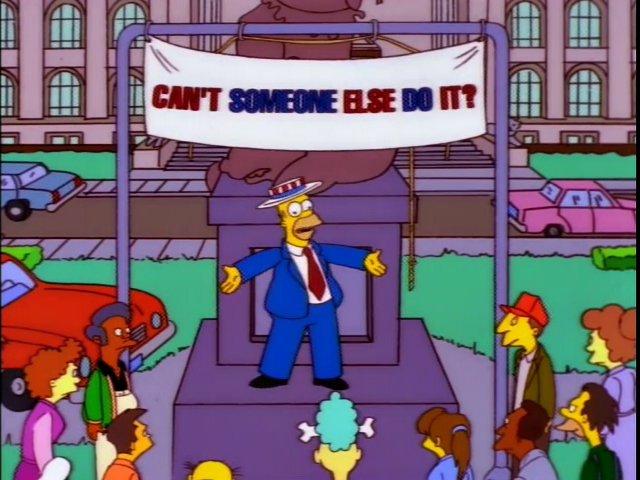
Or, in other words, as Homer Simpson famously campaigned on during his own tilt at a local body governance position ... "Can't Someone Else Do It."

But the trouble is, the clearest and most obvious way in which shopkeepers are able to take the problem into their own hands as it were, is carefully circumscribed by law.

If a dairy-staffer is suddenly inundated with rambunctiously rampaging ragamuffins rapaciously ransacking as many kilograms of cigarettes from his store as they can possibly carry ... said proprietor is pretty much powerless to stop them. They can't exactly physically restrain a perpetrator - there's no specific legal provision to explicitly allow them to do so. The closest law I could find on the subject, s53 of the Crimes Act, tightly constrains the forms of physical intercession available to anyone seeking to use reasonable force in defence of property; and there's strong anecdotal evidence that shopkeepers are simply too afraid of legal repercussions from even something as simple as physically restraining an offender and waiting for the cops to arrive to actually and actively take control of the situation.

They've unfortunately got good cause to be trepidacious. It wasn't so long ago that another shopkeeper - a Mr V. Singh - found himself on the wrong end of criminal assault charges after using reasonable force to defend himself and a co-worker from drunken teenagers armed with a knife who'd invaded his store and stabbed him.

Fortunately, in Mr Singh's case, the charges were thrown out after a certain high-profile defence lawyer offered to get involved and fight Singh's case free of charge - but the chilling effect upon shopkeepers feeling able to defend themselves and their establishments (a deliberate motivation for the police in bringing the charges in the first place) has remained.

I'd say it was only a matter of time before somebody was killed - but incredibly sadly, that's already happened.

So what do we do about this sorry and evidently escalating situation.

Well the obvious answer - and inarguably the best one - is to properly resource the New Zealand Police to actually do their job. New Zealand First secured a thousand extra front-line police plus three hundred support staff the last time we were proximate to Government between 2005-2008, and it's incredibly disheartening that National appears to have undone our good work at the stroke of a series of pens over the last few years. This isn't just an armchair pundit's opinion, however - a massive eighty six percent of front-line officers themselves believe that our Police lack the resources they need to properly do their job. And in light of the Government's frankly inexplicable decision to close a number of cop-shops in the name of cost-cutting, community access to policing is only going to get worse.

So it seems, on the face of it, that improvements in both the quantity and quality of policing to address this issue are off the table.

We must therefore look for alternative solutions, pending the election of an alternative government.

Some shopkeepers want a law-change to explicitly empower them to be able to physically restrain malcontents rather than having to let them walk out the door. While this would obviously solve some of the short-term issues thrown up by the present police shortage - as the inevitable (and lengthening) delay-period between a 111 call being logged and an officer turning up at the scene would no longer provide an enviable opportunity for the perpetrators to melt into the ether - it's a clearly imperfect solution. If there are a half a dozen offenders flash-raiding your shop, as seems to be the new favoured M.O for these sorts of engagements, there's a somewhat limited chance that the one or two staff on-site are likely to be in a position to seriously consider restraining anybody.

That is not to say such a proposal is completely lacking in merit. As applies smaller-scale heists with more limited numbers of offenders such as those common in supermarkets, knowing that shopkeepers and/or security staff have the lawful power to physically detain you while the cops arrive could form a deterrent to committing crime in the first place. The lack of such an easily enactable provision certainly does, at present, encourage the opportunism inherent in this lower-level offending.

At the more serious end of the spectrum, there have also been demands for a clarification of our Nation's self-defence laws. At present, the way these work is that under s48 of the Crimes Act, people are justified (and therefore legally protected) in using "reasonable force" in defence of themselves or others. The trouble is, "reasonable force" is a highly nebulous standard - and subject to quite a myriad of interpolating factors.

Ordinarily, it's up to Police to make a decision as to whether the force used was reasonable, and 'filter out' people who shouldn't be put through the legal system as a result; but the number of charges being thrown out pre-trial would appear to indicate that the Police are often erring too far on the side of caution when it comes to the use of their discretion, and instead taking an approach of leaving such determinations more exclusively up to the judiciary.

While it might seem like a sound legal practice to insist that any application of force in self defence ought to be one that can stand up to exterior scrutiny in court, the plain fact of the matter is that legal bills and other associated costs of proving one's innocence are highly expensive - which leads to the inescapable conclusion that the extant regime is forcing morally blameless people (the victims in these situations no less) to be financially penalized for what later turn out to be perfectly legal (even occasionally outright commendable) actions in self defence.

Clearly, there is some considerable scope for either law or process reform in this area - and that's why in the run-up to the 2014 Election, New Zealand First campaigned upon a somewhat related legislative proposal designed to cover homeowners using force in self-defence against burglars and other intruders. NZF also made strongly approving noises about clarifying the ambit of self defence laws in order to give a greater degree of certainty to people having to use them, so as to hopefully avoid unfortunate repeats of the undesirable situation outlined above.

A final point worthy of mention is that as one of the core underpinnings of this recent wave of convenience-store targeted crime is the increase in cigarette-prices due to excise tax hikes (which have made cigarettes both less affordable, and more relatively valuable on the black market as a result), there remains every likelihood that both the level of offending - and the brazenness with which it is carried out - will only continue to get worse.

All things considered, my innate liberal proclivities mean that I remain somewhat uncomfortable with the notion of ordinary citizens having to take the law into their own hands. Not simply because of the risks inherent to such a position that a defender might go too far; but also, and more fundamentally because in a modern, nominally first-world Nation ... this isn't how things ought to be. People shouldn't *have* to take the law into their own hands, because our Police ought to be properly resourced. Shortfalls in political will and material support for law enforcement are not factors that should be allowed to force us into a corner and contemplate either accepting crime as a day-to-day cost of doing business here in New Zealand, or put the onus on regular New Zealand citizens to defend themselves and their property from the economically violently indigent.

And yet, here we are.

It shouldn't take another shopkeeper being stabbedbadly beaten, or even killed to get this issue taken firmly in hand. However we choose to do it.

We can't just let this keep happening.