Showing posts with label Coalitions. Show all posts

Monday, June 23, 2014

East Coast Blase

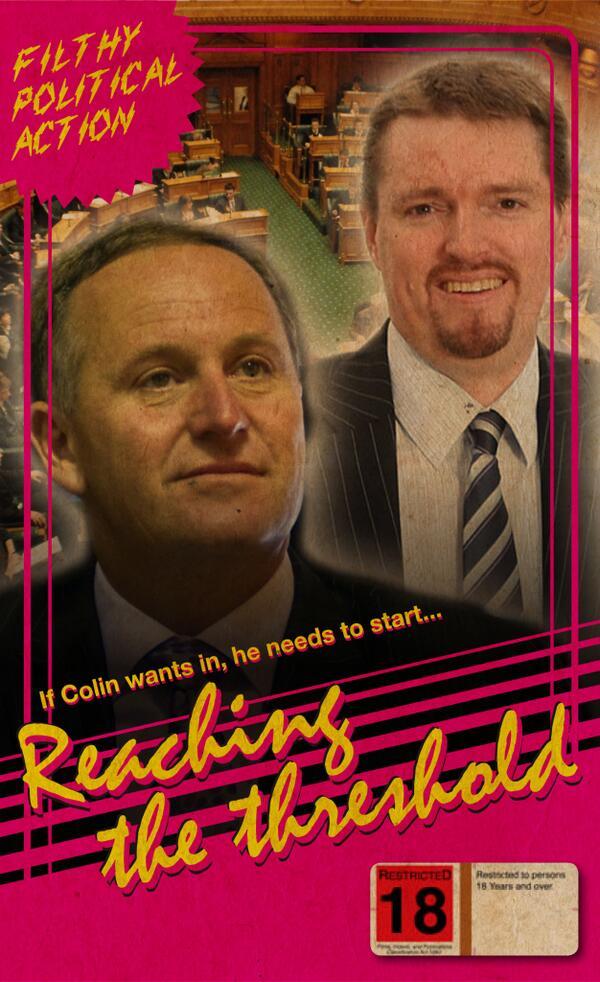
There's something really, really stupid afoot in the electorate of East Coast Bays. You see, a specter is haunting the North Shore. A specter of Conservatism! And whether Murray McCully, or Jamie Whyte ... all those on the Right whom you'd assume would be bitterly opposed to an electoral accommodation with New Zealand's David Brent-iest new kid on the block, instead appear to be queuing up like frankincommonsense-bearing Magi to help celebrate and anoint the birth of a new political movement.

So what's going on up there?

Well, in terms simple enough for the average Conservative voter ... Colin wants to stand on his own two feet like a big-boy party, and crack 5% under his own steam. Except he also wants to try and win an electorate, because he's not actually that confident of being able to drag an additional 40,000 voters with him. Again, on his own two feet and under his own steam, rejecting Epsom style Two Parties One Cup (of Tea) deals with the National Party as "bland and insipid" (funnily enough, also the words I'd use to describe Craig). Except he would welcome such a deal, were it offered to him, because it would ensure him a place in Parliament.

So to sum up, this is the curious case of a man who wants to crack 5%, acknowledges that it's rather unlikely that he can; rejects Cup of Tea deals on point of "insipid" principle, yet welcomes Cup of Tea deals because ultimately power (or, more charitably, the ability to give effect to principle) trumps principle. Following so far?

And yet right wing commentators [trigger-warning: Failoil] had the nerve to mock the Internet Party's strategic use of the coat-tailing provision as "hypocrisy"!

The only slight fly in the ointment (apart from Colin, of course) is that voters in East Coast Bays aren't viewed as likely to play ball. Craig himself is of the opinion that he'd have to "run unopposed" in East Coast Bays to actually pull off a victory there; a statement which either indicates that his own personal polling of ECB has been *that bad* for him ... or, more likely, that even when staking out the most important make-or-break deal of his political career, he's horrendously gaffe-prone. Either of these phenomena (Craig's penchant for embarrassing flailing; right-wing ECB voters potentially having more electoral backbone than right-wing Epsomites; or even growing discontent with coat-tails deals generally) may be responsible for the National Party's sudden iffyness about a deal with Craig.

John Key's gone from what passes for reasonably strong language by his standards ("I'm not ruling it out, but neither would I say that we're absolutely going to do a deal") that appeared to indicate the Nats were seriously and strongly considering an accommodation; through to the Prime Minister's suggestion this morning that voters, pundits, and iPredict users "don't bet the ranch" on McCully standing aside in ECB. Murray McCully, meanwhile, went from "leaders and boards of parties do make strategic decisions" last week, to "I have enjoyed strong support from the people of East Coast Bays in past elections. This year I will be campaigning strongly to seek their support again" yesterday. He issued that statement direct from the Islamic Republic of Iran, so I suppose it's pretty good, given what's going on in his home electorate, that McCully's getting in some early practice working closely with theocrats with bad reputations on certain issues.

This concern about Craig's candidacy potentially doing more harm than good to National's own branding, in return for a negligible shot at Craig actually winning a seat, assumedly also explains why both One and 3News yesterday had National Party sources surreptitiously attempting to pour cold upon the idea of a deal. The fact they're even still publicly considering a deal with the Cons (or, at least, refusing to publicly rule one out) indicates just how absolutely and incredibly desperate Key is to avoid the possibility of having to do a deal with Winston.

Of course, it's also possible that National has taken frank stock of its newfound coalition "ally", looked at what they "stand" for, and decided that provided they're still above 50% in most disreputable polls with Seymour on course to nascently bonbon-snatch the electorate of Epsom ... they'd rather not have to get too close to the Cons, thanks. And given the Conservative Party is apparently the sort of organization whose number 3 candidate at the last election (Larry Baldock) professes Conservatism of a sufficiently Jim Crow flavour that he believes that "inter-racial relationships" are a social evil on par with alcoholism, necessitating censorship in the media; while their number 10 candidate last time and campaign manager Kevin Campbell [trigger-warning: Kiwiblog] apparently thought the disabled should be barred from becoming MPs, and that "John the Jew" was an acceptable way to refer to the Prime Minister ... I can well understand why the National Party would be all too eager not to get too close, thus necessitating such ... interesting courtship displays from Craig.

Besides, the position of annoying talking animal has already been filled.

So where does this leave Craig?

In possession of polling that shows he'd lose less hard in East Coast Bays than he would in Rodney, apparently. Although given Craig's previous penchant for dodgy polling - as evinced by the 2011 incident wherein he trumpeted results showing him winning Rodney ... against outgoing National MP Lockwood Smith, who wasn't even *contesting* Rodney at that election, or the 2013 incident wherein Christine Rankin managing 24% in Upper Harbour (versus 20% for "Other Candidate" and a massive 56% "Undecided") [trigger-warning: Kiwiblog; Colin Craig using the word "Catfight"] apparently made for a "no-brainer" candidacy - who knows what this would actually mean in practice.

The only things we've really got to go on about Craig's self-projected impact on this year's general election, is that he's targeting National voters, running a right-wing-and-referendums ticket of "One Law For All", being tough on crime (i.e. stupid on parole), and rather expansive tax cuts, and apparently thinks comparing himself to Social Credit is a surefire ticket out of the loony-bin also-ran section of the 21st century electorate's consciousness.

(incidentally, as a brief digression ... why is it that parties promoting a "One Law For All" agenda invariably seem to do so exclusively on the basis of race? If strict legal equality for all New Zealanders is such a desirable policy vibe, then what's the issue with extending this "one law for all" egalitarianism to other groups in society, like sexual minorities, or women? Oh. Right. That.)

Anyway, he's also taken a rallying cry ("Stand for something!") that seriously reminds me of then-FOX personality Glenn Beck's famous line "Believe in something! Even if it's wrong! Believe in it!"; and while there is a certain appeal to "Stand against Craig!" as a counter, the slogan-for-victory we should all be out there chanting in the electorate (particularly if you're in a North Shore electorate demarcated for Rotten Borough status by National) is ...

"A Vote for National is a Vote for Colin Craig!"

Tuesday, November 20, 2012

W(h)ither the Maori Party?


Wither the Maori party.

Sorry, that's probably a little harsh.

Whither the Maori party?

At their party conference held last month, the Maori party explored ways to rejuvenate and diversify the party’s image, support base and electoral prospects. These ranged from the fairly predictable, in the form of a remit to begin a leadership transition process for MP Te Ururoa Flavell and a renewed emphasis on running a party vote campaign; through to more surprising suggestions including a desire to substantially increase the party’s support among non-Maori.

These two goals – diversifying (some might say diluting) the party’s constituency and improving its flagging electoral prospects - are closely interlinked, and have come about as a strategic response to changes in the political terrain and the party.

The Maori party's electoral model has previously been conditioned by two elements: its mechanism for returning MPs to the House through the strong likelihood of its holding several of the Maori Seats, and the party's self-perceived function within the House as representation for Maori. This has contributed toward its initial incarnation as a fiercely partisan protest party and its more recent desire to be a (Treaty) partner in government.

It was fortunate enough to be able to fight its first two General Elections in favourable political terrain. In 2005, the recent salience of the Foreshore and Seabed issue provided a potent mobilizing force for the Maori party's target constituency. This played a strong role in establishing some of the initial populist and identity-politic appeal of the party as an independent/organic voice for Maori in a potentially unrepresentative democratic and policy process.

More importantly, as a unified opposition to Labour in the Maori seats (and representing the most successful challenger to Labour for the Maori seats since New Zealand First) the Maori party was able to capitalize upon being the only other real option for voters in these seats. It also may have gained substantially from a probable tactical elector intent of vote-splitting by giving their party vote to Labour and their electorate vote to the local Maori candidate in the belief that if the Maori party candidate were successful, the Labour candidate would also ideally make it back into Parliament on the party list. (between 2005 and 2008 this happened by my estimation five times)

The Maori party successfully parlayed these favourable conditions into 2.12% and 4 electorate seats in 2005, and a more robust 2.39% and 5 seats in 2008. These majority shares of the 7 Maori seats (with only 2 non-Maori party MPs in the seats after the 2008 election) certainly did not harm the party's effective reputation as the only game in town for being both a successful 'organic' indigenous political movement, and challenging Labour's dominance on Maori issues and perceived monopolization of Maori representation.

In 2011 however, it was different. The battle for the Maori Seats had become a three-way competition with the credible entry of the MANA party onto the scene in the Te Tai Tokerau by-election in June of that year. Further, the Labour party's effort in the seats was bolstered by having been in Opposition for the previous three years. No longer being in government meant Labour could spend less time defending its historic controversies and more time attacking the Maori party's role in government. This reversed the tables on the previous two elections, which had seen an 'outsider', independent and aggressively partisan Maori party seeking to call Labour's government to account. The Maori party's entry into governance back in 2008, by contrast, had eroded their credibility as either a protest party or an independent voice. This situation was only exacerbated by the emergence of an electoral alternative in the form of the MANA party more strongly focused on the protest element of Maori representation and which had staked out its partisan principles by defecting from both government and the Maori party.

In electoral terms then, it should hardly be surprising that the party's result declined proportionately. They had previously lost an MP and a safe seat when Hone Harawira defected prior to the Te Tai Tokerau by-election meaning they went into the 2011 general election with a Caucus of 4. On election night, they lost both Te Tai Tonga (to Labour's Rino Tirikatene) and 0.96% of their vote. Interestingly, MANA polled 1.08% of the popular vote; and, in Te Tai Tonga, just under the margin by which incumbent Maori MP Rahui Katene lost by. This leads to the obvious if somewhat unverifiable conclusion that the MANA party were directly responsible for the loss of two seats and perhaps up to a percent of popular vote for the Maori party.

It also handily demonstrates the point that competing within the Maori Seats can be something of a zero sum game. There are only 7 seats to be won, and although the Maori Party had managed to credibly organize and deliver results while these contests were substantively two party races, the addition of a third competitor has increased the investment necessary for any party to generate a return from putting effort into increasing their share of these seats.

Additionally, the strong correlation between the percentage of party votes lost by the Maori party with that gained by the MANA party may indicate that campaigning for the party vote associated with Maori representation is a situation of similar limitations and diminishing marginal returns. Although the extent of the nominal Maori electorate in terms of the return it can deliver through party vote is far more nebulous than the fixed seven seats available from the Maori electoral roll, the strong overlap between the MANA and Maori parties in rhetoric, identity politik focus and previous preferred constituencies means that they are inevitably going to be competing for many of the same party votes.

The defection of Hone Harawira before the 2011 election from the 'insider' Maori party to form his own 'outsider' protest movement represented in part a growing dissatisfaction within the Maori party's existing voter base at the conciliatory approach the party had taken toward National and the perceived erosion of the party's values which had thus ensued. The impact of MANA upon the Maori party's 2014 vote prospects then needs to be understood not just in terms of encouraging a large chunk of the party's supporters, candidates and activists and nearly half their party vote to up and leave with Harawira; but rather by the way the existence of a new, independent and fiercely partisan protest movement with an emphasis on Maori representation and Maori nationalism/identity politics directly competes for and may have delegitimated much of the Maori party's perceived strength in these areas. In effect, Harawira's defection conditioned and solidified emerging negative narratives about the Maori party (a succinct, if extreme summation of which would be Harawira's own recent "house niggers" comment, perhaps more politely phrased as "sellouts and hood-ornaments"), while also creating an alternative dedicated to those functions of protest, independence and social justice that may have been perceived to be neglected by the Maori party. This has had the strategic effect of increasing the effort and difficulty of appealing to these voters and parts of the electorate, while also forcing the Maori party to redefine its image and narrative in response.

Facing 2014 then, the Maori party has found itself faced with some stark strategic choices to make regarding its electoral future.

At its conference, it decided to
defer the motion to initiate a leadership transition for Te Ururoa Flavell. This keeps its two experienced co-Leaders occupying both their positions and their winnable electorate seats for the foreseeable future, and capitalizes upon strong pre-existing electoral and representational records for both these MPs and seats. It also keeps the leadership option open for future use if a successful challenge of Sharples by Shane Jones in Tamaki Makaurau looks likely (as was nearly the case in 2011, with Jones only behind by 936 votes); or alternatively if Flavell needs a profile boost in the event of a close race for Waiariki (which, despite his appreciable margin of 1,883 votes over MANA President Annette Sykes in 2011, is possible).

Interestingly, the Maori party also expressed a
desire to appeal to more non-Maori voters and supporters or even stand non-Maori candidates; which, while perhaps somewhat at odds with the party's earlier emphasis upon being a party of Maori speaking for Maori, is nevertheless a logical reaction to the increased difficulty the party is clearly faced with in pursuing its existing strategy of focusing more exclusively on attracting Maori supporters or the Maori vote. In essence, the Maori party has seen the comfortable political nieche it had previously occupied become altogether less hospitable with the addition of a direct competitor who has seized and demarcated out a swathe of it for his own. This has led to a corresponding increase in the effort which the Maori party must invest in competing with its close rivals for votes and supporters in its traditional constituencies, which has no doubt encouraged the Maori party to consider how it can appeal to electors outside these hotly contested battlegrounds as a source of members and electoral support.

One obvious way it could do this is by seeking to capitalize upon the well-developed perception that National will struggle to find "stable" coalition partners with whom they are both reasonably ideologically compatible and whose likely future Caucus composition will need more than a phonebox (or coffin) sized space to meet in.

The Maori party's strong record in governance of policy delivery and good faith partnership and negotiation - and, indeed, their strong emphasis upon being a "partner" in government - allows them to market themselves as an effective centrist party and a coalition partner for National with long-term viability. While it may be some time before we see tactical voting for the Maori party by National supporters, this role as both a prominent centrist voice and a dependable coalition partner may yet provide additional electoral appeal as they seek an increased party vote. The ideological (or at least rhetorical) heritage of the party's Caucus may also potentially allow it to work with Labour in a post-election situation, giving a party vote for the Maori party an added dimension of utility for non-Maori voters seeking an alternative centrist electoral option.

The ability and willingness of the party to brand itself as a centrist electoral option was shown by Turia's recent choice to characterize the focus of the party as being upon "housing, employment, education and whanau ora". This list of three broad-appeal goals and one prominent legacy item may serve to convey a centrist appeal with a Maori flavour rather than a Maori appeal with a centrist flavour. This de-emphasis of Maori isssues allows an avoidance of conflict with MANA in areas of shared appeal, while the focus on both the legacy item and gains in deliverable policy areas allow the Maori party to compete with rival parties from the Opposition in ways that emphasise their point of difference as a governmental 'insider' party.

The shift from goals more obviously identifiable as Maori in appeal (for example, securing recognition for the Tino Rangatiratanga flag) to those which, while they might have more importance for Maori are nevertheless of general appeal (such as improvements in "housing, employment [and] education") also plays strongly into its drive to diversify its support base and electoral prospects by recasting its role as delivering outcomes applicable to if not all New Zealanders, then at least more of them. And, if the Maori party is serious about pursuing a broader appeal and attracting voters and activists from outside of its traditional constituency, promulgating goals they can also identify with and have a stake in is important.

The Maori party's putting such a prospective focus on marketing itself in these areas can also be seen as a response to the challenges the party is facing in fostering and retaining voters and
members (the number of which has reportedly slumped to 600), activists and candidates through its existing focus on the Maori electorate and electors. While this declining trend may well already have been in evidence prior to 2011, the emergence of the MANA party has exacerbated it; and, due to MANA's strong competition for these same core electors and activists, made it much harder to reverse.


The existence of MANA has also tightened the contests for both the Maori Seats and broader Maori electorate and thus worsened the situation of diminishing marginal returns which any party (particularly the presently dominant incumbent) faces in terms of having to put in ever-increasing effort for uncertain and limited electoral (indeed, somewhat 'all-or-nothing') returns. I would be honestly surprised if the Maori Party increased their share of the Maori Seats from 3 to 4 or more at the next election. Instead, they could conceivably lose one or more seats to either MANA or the Labour Party. Their ability to rely on a strong return in the Maori Seats to ensure the party's parliamentary presence remains viable and grows is thus curtailed, which leads to their understandable renewed emphasis on campaigning for the party vote in both the broader and Maori electorates.

The interesting thing about the Maori party's party vote strategy is that it generates a greater relative return the worse they do in the Maori Seats. This is because to take advantage of any gains in party vote, the Maori party's share of the vote must entitle them to more MPs than they would otherwise have gained through electorate wins. To date, this has never occurred due to the Maori party's strong returns in the Maori Seats and their comparatively weaker returns on party vote.

However, as they will have only three electoral seats going into the 2014 General Election and face the very real possibility of losing one of those, they would only have to improve their share of the party vote to about 3.3% if they hold all 3 of their existing Maori Seats to gain 1 List MP for a restored Caucus of 4. Alternatively, if they lose an electorate seat then they would only require about 2.5% of the party vote to benefit from an additional List MP to maintain in size if not exact composition their Caucus of 3. As a point of reference, the latest Roy Morgan poll had them on 3.5%, making the benefits of pursuing a party vote strategy quite obvious - whether as electoral insurance or as a means for growth.

Given the strong challenges the party now faces in appealing to its traditional constituency which looks set to contribute to a relatively stagnant or declining electoral return from the party's Maori constituency, and the consequent expanding utility of both a party vote campaign and appealing outside that constituency, the rhetoric emerging from this year's Maori party conference over these issues is entirely unsurprising.

The Maori party does not necessarily face immediate extinction; and, with its decision to continue on with its existing leadership team, it can probably be assured at least a presence in Parliament after the next election.
However, its attempts to be the 'elder statesman' of Maori politics are finding themselves undercut by the youthful vigour of the MANA party and reasonable challenges from experienced Labour campaigners.
It may well have sat down, engaged in a rational decision-making process and come to the conclusion that its prospects for attracting support or a future from a vision and focus directed more exclusively toward Maori are becoming somewhat stagnant, and that the best thing to do going forward is to parlay the party's existing prominence as a strong and stable centrist coalition partner whose Caucus have reasonable profile and respect into a broader electoral appeal.

If it is serious about this effort, it will face an additional issue in the form of heightened questions about the nature of its character, values, identity and legitimacy; particularly given the previous adverse consequences of its earlier transition of identity from 'outsider' protest party to 'insider' member of the governing establishment. 

While its supporters will no doubt be reassured that the party has decided to rebuff speculation that it might drop the word "Maori" from the name, will the Maori Party one day be Maori in name only?

Sunday, November 13, 2011

"When you sup with the Neoliberal ... use a long-handled spoon"

Much has been made this week of NZF's surge in the polls. We thank the media for finally deciding to sit up and take note of what's sure to be one of the more interesting stories this election - our comeback.

However, a surge in Peters-popularity inevitably causes all manner of spurious allegations to come out of the woodwork from the man and the party's detractors. We've already seen the re-hashing of hackneyed versions of the Owen G Glenn saga which omit to mention the police report finding in Winston's favour. Others have sought to raise the specter of Winston the Kingmaker, calling him a reason to vote against MMP due to his deftness at post-election negotiation.

Certain elements in the media (chiefly in my mind this morning's Sunday Herald editorial) are now attempting to undermine our post-election coalition position by spinning the hell out of our two previous Near-Government Experiences (rather like a near-Death experience except with more bureaucracy).

The customary opening claim runs "in 1996 Winston campaigned on destroying National and then went into government with them."

This is then followed with disparaging remarks about the 2005 arrangement, which usually attempts to seriously mis-characterise NZF's interaction with the then-Labour government.

What they're saying is that NZF can't be trusted to *remain* in opposition once we return to Parliament.

Their general thrust is plain - "you shouldn't trust Winston to keep the Government honest in 2011".

Which is ridiculous. Here's why. John Key has ruled Winston out. Winston has ruled John Key out. John Key has ruled out not selling assets. Winston has *very emphatically* ruled selling assets out. There is thus prima facie no reason to assume NZF will go into government with National in 2011.

The counter-factual narrative then usually ripostes by suggesting that New Zealand First had ruled National out in 1996. This is severely misinterpreting Winston's remark that "the price of a coalition agreement ought to be Jim Bolger's head". And, as it turned out, the price of a coalition agreement was more to the tune of ending asset sales, keeping ACT out of government, free doctor's visits for under-6s and moves toward compulsory national savings and a universal student allowance.
Or, in other words, New Zealand First hadn't ruled out National, and made substantial gains and unquestionable gains for New Zealand by going into coalition.

This contrasts markedly with 2011, wherein Winston has very definitely ruled out National; although I suppose it torments the Business Round Table no end to speculate whether he might reverse this position and entertain negotiations ... if he were to re-take his old Treasurer role and once again end the neoliberal agenda of a wayward National party.

Interestingly, it also contrasts rather markedly with the post-election stance adopted by The Greens, who consistently refuse to rule out National.
This despite its highly publicised recent use of Robyn Malcolm to castigate the Prime Minister and its seemingly-now-abandoned taxation egalitarianism.

Our logic, in effect, was this. We cannot in good conscience go into government with a major party that plans to destroy and to cheapen the nation that we love. National's second term agenda is precisely this.
They have declared they will not countenance any party which won't aid and abet them in this.
The Maori Party voting to raise GST to 15% and make our tax system more unfair as the price of its confidence & supply votes is a prime example.

National have said they will stake their second term on partial asset sales. They're hell-bent on it.
They've supped tea with the Neoliberals in Epsom to try and bring their partners in crime ACT back to help them. The record of both parties in office also suggests frank economic incompetence. Under this three-ring political circus, we've seen a massive increase in the number of Kiwis seeking a Brighter Future in Australia.
We've seen rampant inflation, rampant public debt to pay for unfair tax cuts, and rampant spending cuts to both the public purse and our own wallets. We've seen all manner of shadowy constitutional and economic posturing. We've seen the Foreshore & Seabed and aspects of our economic sovereignty quite literally given away. The record of the last three years suggests the Key-lead government might well have resembled the bridge of the Rena.

Foreign Owned.

Any party which is not prepared to rule out coalition with National is, in effect, refusing to rule out assisting National in the despoilment of the country which we hold so dear.
Any party which is not prepared to be honest with voters about its post-election posturing has something to hide.

There would have to be some seismic shifts in heaven, earth, and National Party ethos before coalition with them became an idea which any party genuinely committed to social justice and national sovereignty could support.