Showing posts with label John Key. Show all posts

Monday, June 23, 2014

East Coast Blase

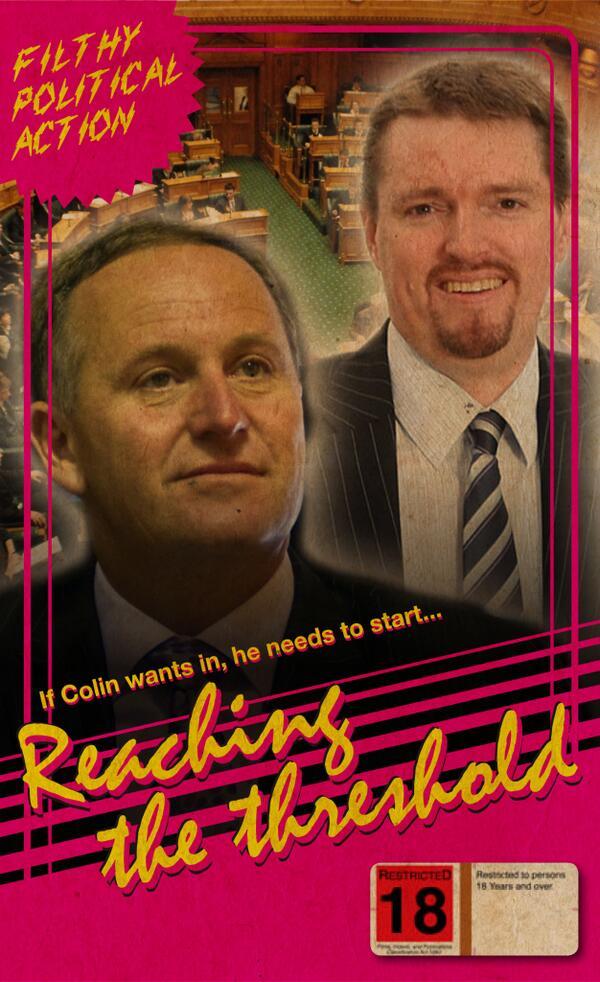
There's something really, really stupid afoot in the electorate of East Coast Bays. You see, a specter is haunting the North Shore. A specter of Conservatism! And whether Murray McCully, or Jamie Whyte ... all those on the Right whom you'd assume would be bitterly opposed to an electoral accommodation with New Zealand's David Brent-iest new kid on the block, instead appear to be queuing up like frankincommonsense-bearing Magi to help celebrate and anoint the birth of a new political movement.

So what's going on up there?

Well, in terms simple enough for the average Conservative voter ... Colin wants to stand on his own two feet like a big-boy party, and crack 5% under his own steam. Except he also wants to try and win an electorate, because he's not actually that confident of being able to drag an additional 40,000 voters with him. Again, on his own two feet and under his own steam, rejecting Epsom style Two Parties One Cup (of Tea) deals with the National Party as "bland and insipid" (funnily enough, also the words I'd use to describe Craig). Except he would welcome such a deal, were it offered to him, because it would ensure him a place in Parliament.

So to sum up, this is the curious case of a man who wants to crack 5%, acknowledges that it's rather unlikely that he can; rejects Cup of Tea deals on point of "insipid" principle, yet welcomes Cup of Tea deals because ultimately power (or, more charitably, the ability to give effect to principle) trumps principle. Following so far?

And yet right wing commentators [trigger-warning: Failoil] had the nerve to mock the Internet Party's strategic use of the coat-tailing provision as "hypocrisy"!

The only slight fly in the ointment (apart from Colin, of course) is that voters in East Coast Bays aren't viewed as likely to play ball. Craig himself is of the opinion that he'd have to "run unopposed" in East Coast Bays to actually pull off a victory there; a statement which either indicates that his own personal polling of ECB has been *that bad* for him ... or, more likely, that even when staking out the most important make-or-break deal of his political career, he's horrendously gaffe-prone. Either of these phenomena (Craig's penchant for embarrassing flailing; right-wing ECB voters potentially having more electoral backbone than right-wing Epsomites; or even growing discontent with coat-tails deals generally) may be responsible for the National Party's sudden iffyness about a deal with Craig.

John Key's gone from what passes for reasonably strong language by his standards ("I'm not ruling it out, but neither would I say that we're absolutely going to do a deal") that appeared to indicate the Nats were seriously and strongly considering an accommodation; through to the Prime Minister's suggestion this morning that voters, pundits, and iPredict users "don't bet the ranch" on McCully standing aside in ECB. Murray McCully, meanwhile, went from "leaders and boards of parties do make strategic decisions" last week, to "I have enjoyed strong support from the people of East Coast Bays in past elections. This year I will be campaigning strongly to seek their support again" yesterday. He issued that statement direct from the Islamic Republic of Iran, so I suppose it's pretty good, given what's going on in his home electorate, that McCully's getting in some early practice working closely with theocrats with bad reputations on certain issues.

This concern about Craig's candidacy potentially doing more harm than good to National's own branding, in return for a negligible shot at Craig actually winning a seat, assumedly also explains why both One and 3News yesterday had National Party sources surreptitiously attempting to pour cold upon the idea of a deal. The fact they're even still publicly considering a deal with the Cons (or, at least, refusing to publicly rule one out) indicates just how absolutely and incredibly desperate Key is to avoid the possibility of having to do a deal with Winston.

Of course, it's also possible that National has taken frank stock of its newfound coalition "ally", looked at what they "stand" for, and decided that provided they're still above 50% in most disreputable polls with Seymour on course to nascently bonbon-snatch the electorate of Epsom ... they'd rather not have to get too close to the Cons, thanks. And given the Conservative Party is apparently the sort of organization whose number 3 candidate at the last election (Larry Baldock) professes Conservatism of a sufficiently Jim Crow flavour that he believes that "inter-racial relationships" are a social evil on par with alcoholism, necessitating censorship in the media; while their number 10 candidate last time and campaign manager Kevin Campbell [trigger-warning: Kiwiblog] apparently thought the disabled should be barred from becoming MPs, and that "John the Jew" was an acceptable way to refer to the Prime Minister ... I can well understand why the National Party would be all too eager not to get too close, thus necessitating such ... interesting courtship displays from Craig.

Besides, the position of annoying talking animal has already been filled.

So where does this leave Craig?

In possession of polling that shows he'd lose less hard in East Coast Bays than he would in Rodney, apparently. Although given Craig's previous penchant for dodgy polling - as evinced by the 2011 incident wherein he trumpeted results showing him winning Rodney ... against outgoing National MP Lockwood Smith, who wasn't even *contesting* Rodney at that election, or the 2013 incident wherein Christine Rankin managing 24% in Upper Harbour (versus 20% for "Other Candidate" and a massive 56% "Undecided") [trigger-warning: Kiwiblog; Colin Craig using the word "Catfight"] apparently made for a "no-brainer" candidacy - who knows what this would actually mean in practice.

The only things we've really got to go on about Craig's self-projected impact on this year's general election, is that he's targeting National voters, running a right-wing-and-referendums ticket of "One Law For All", being tough on crime (i.e. stupid on parole), and rather expansive tax cuts, and apparently thinks comparing himself to Social Credit is a surefire ticket out of the loony-bin also-ran section of the 21st century electorate's consciousness.

(incidentally, as a brief digression ... why is it that parties promoting a "One Law For All" agenda invariably seem to do so exclusively on the basis of race? If strict legal equality for all New Zealanders is such a desirable policy vibe, then what's the issue with extending this "one law for all" egalitarianism to other groups in society, like sexual minorities, or women? Oh. Right. That.)

Anyway, he's also taken a rallying cry ("Stand for something!") that seriously reminds me of then-FOX personality Glenn Beck's famous line "Believe in something! Even if it's wrong! Believe in it!"; and while there is a certain appeal to "Stand against Craig!" as a counter, the slogan-for-victory we should all be out there chanting in the electorate (particularly if you're in a North Shore electorate demarcated for Rotten Borough status by National) is ...

"A Vote for National is a Vote for Colin Craig!"

Monday, June 2, 2014

On Very Wealthy Men Buying Political Parties

On Thursday, the Prime Minister decided to describe Kim DotCom as "a very wealthy guy trying to buy a political party".

Now, ordinarily I'd be inordinately tempted to just discount out of hand as ribald sledging virtually anything the PM said about his most enduring political opponent ... but then I remembered that when it comes to very wealthy guys attempting to buy political parties, John Key is in a pretty uniquely experienced position to tell us what's what.

Let's start back in 2005, an election wherein "very wealthy guys" seemed to pop up like mushrooms to finance or otherwise contribute to the National Party's campaign, necessitating questions about who was *really* in control of National's policy agenda.

Flashing forward to 2011, National picked up absolutely incredible quantities of money from various Chinese business donors - the figure cited in the hyperlink is more than a hundred thousand dollars inside eight days, the majority of which came from a small little company nobody's ever heard of, called Oravida, and which was deposited four days after the election on November 30th. I also wasn't aware, up until researching this part of the story, that Oravida was actually set up by Terry Lee, a figure closely associated with the Shanghai Pengxin bid to buy up the Crafar Farms.

While we're talking Crafar, there's also the small matter of the $200,000 worth of donations to National from a Chinese husband-and-wife team closely associated with both Jack Chen's Natural Dairy NZ attempt at acquiring the Crafar Farms, as well as then-Cabinet Minister Pansy Wong.

(Pansy Wong's dumping as a Minister, you may recall, eventuated as the direct and attributable result of her facilitating her husband's commercial ventures in China, including the use of taxpayer funded travel and her position as a Minister for her husband's commercial gain. Now where have we heard that before?) 

And then National (in the persons of Minister Maurice Williamson, whom we'll be meeting later in this piece, in the company of Donghua Liu; and Jonathan Coleman, whom we'll also be meeting later, in the company of British American Tobacco) engaged in some questionable executive conduct to get the sale approved.

Looks interesting, doesn't it.

More recently, we've been treated to the unwholesome spectacle of a bunch of "very wealthy men" doing something even worse than "trying to buy a political party":

They've been successfully buying the attentions and action of the whole bloody government, in the form of having Ministers of the Crown literally go out of their way to help the donors in question, and other special treatment.

The Donghua Liu case really gets to the heart of what's going on here: a wealthy man takes advantage of his exclusive connections within Nat circles in order to have official advice overturned, non-compliant officials put in the cross-hairs of Ministerial attention, and a potential appearance of endorsement of commercial projects into the bargain - all for the relatively modest sum of $22,000 .

In this case, it's then-Minister Maurice Williamson, alongside then-Mayor of Auckland and present-day National-linked Satrap of ACTistan John Banks (whom we'll also be meeting later, both in the company of a certain "very wealthy man trying to buy a political party" and again lobbying officials and Ministers on behalf of the donor) successfully lobbying the Immigration Minister to go against official advice and approve Liu's application for NZ citizenship; followed up by his friend-in-high-places intervening on Liu's behalf to question a "senior police officer" about whether the Police were really sure they were "on solid ground" in pursuing Liu over domestic violence charges. Williamson's grounds for intervening are telling: according to the officer in question, Inspector Gary Davey, his grounds for doing so were that "Mr Liu is investing a lot of money in New Zealand". How about that. 

No catalogue of the nefarious linkages between wealthy businessmen and the National Party would be complete, however, without an attempt at crying foul over spilled milk in relation to the ongoing Oravida Affair.

This is pretty much the apotheosis of "very wealthy men buying political parties" in New Zealand right now, and features what appears to be an impressively long-running campaign by Oravida to inculcate its influence - and the appearance of having influence - in the highest corridors of power in the land. 

In this case, things appear to have started with a golf game. Oravida's high-ups apparently decided to pay $56,600 in order to tee up a round of golf with the Prime Minister. Photos of said golf game were then splashed across Oravida's website, as part of the latter's ongoing efforts to flaunt its close connections and ease-of-access with important Kiwi politicians. 

The golf game also looks rather dodgy from the Kiwi-side perspective. Think about it this way - what's happened here isn't (as initially claimed by National) a very wealthy man winning a charity auction for a game of ball-sticks in a field somewhere avec a National notary as the prize ... it's a very wealthy man spending more than fifty thousand dollars to buy several hours of the Prime Minister's time in a secluded location so they're able to talk privately. This sort of scandal is known as "cash-for-access", and while we'll meet a more widespread instance of such later in this piece with the Cabinet Club, the Oravida example goes well above and beyond the usual donation-for-a-spot-of-lunch-with-someone-important - both in terms of its brazenness (usually the participants don't brag about this sort of engagement all over their websites), and the scale and scope of the "access" involved. 
We then had a series of interesting revelations concerning the timing of Oravida's attempts to smooth Chinese border security requirements, the identity of Mrs Collins' anonymous dinner partner (a Chinese customs & border control official, apparently - from the AQSIQ), and a subsequent backhander donation to the National Party to pay for it all.

Never mind the singularly impressive cavalcade of Nat MPs, party functionaries, and even Prime Ministers (yes, that's an intentional plural) whom Oravida was able to wheel out for the grand openings of its offices; or the way it was then able to monetize these connections - this access - into advertising revenue for its milk, scampi and general (literal) brand ambassadorship ... as you can see here, by seeking governmental assistance in easing border restrictions, then receiving (clandestine) governmental assistance in the person of Collins to personally lobby an AQSIQ official to secure this, the Oravida affair crossed the line from "cash for access" into full-blown "cash for influence".

With the meter running into the tens of thousands of dollars for the purposes of Prime Minister-rental and Collins-deployment, and a time-span stretching for about three years from initial deposit to final pay-off, it seems fair to state that this was less an instance of Oravida paying for the services of senior Cabinet members by the hour, and more one of their having "bought" a political party - or at the very least, having entered into an incredibly long-term, easy-conditions lease of one.

Of course, there are potentially worse things than Oravida lurking out there in the political wilderness. At least when it came to *that* instance of very wealthy men purchasing a political party, we knew exactly who was involved - and, for the most part, when.

The problem associated with National's "Cabinet Club", and Key's expensive fundraiser dinners at Antoine's, is that because the admission fee to these events is below the fifteen thousand dollar threshold at which donations must be declared, the general public has literally no idea which "very wealthy men" out there have been stumping up something like $165,000 for some intimate personal time with the PM.

At least when the Maori Party pulled the same trick down at the Northern Club, we found out pretty sharpish whom the moneyed hands were who could afford to contribute $5,000 a head in order to play musical chairs for best "ease of conversation", "confidentially" with the Prime Minister.

Now let's be clear about all of this. There is absolutely no problem, in a representative democracy such as ours, with ordinary citizens like you and me managing to talk to an MP or Minister, and getting their help in our affairs. Indeed, the entire system is built around exactly this - egalitarian access to the movers and shakers of our polity, so as to allow the citizenry to move and shake things (or at least, to have some input into what's moved, and who's shook).

The problem arises when some small coterie, cabal, or company of citizens (or, as the case may be, Permanent Residents) manage to use their resources and propinquity - whether fiscal, physical, or some other mechanism entirely - to secure access or influence over our nation's decision makers in the way the rest of us cannot. Because then, well ... money talks - and the danger is that it talks far louder and more effectively than those of us who must go cap-in-hand to our elected representatives.

The examples in this piece thus far have all shared a number of points in common: "very wealthy men", or the friends and families of National Party Cabinet Ministers, parlaying their financial resources or familiar ties into opportunities for access or influence - indeed, into actual outcomes - that would not be ordinarily possible for any other New Zealander.

That's why so many Kiwis find National's antics over donations recently to feel "not right" in the gut. Because we know this isn't how a system that theoretically runs on a principle of "one man, one vote" and "Jack is as good as his 'master'" is supposed to work.

We all know that certain groups in Kiwi society tend to have closer links to politicians and political parties - think the Business Round Table with ACT/National, or some unions with the Labour party. Indeed, for the best example going of small groups exerting questionably accountable (or transparent) influence over the policy process and politician-access of political parties, look no further than each party's Youth Wing.

With the occasional exception of right-wing commentators and spectators whinging over the allegedly plenipotentiary role of the unions in connection with the Labour party, nobody seriously alleges that this represents a fraught or iniquitous situation that's injurious to democracy. This is at least partially because everything's supposedly conducted above board and with a reasonable appearance of transparency - we know, for the most part, who's paid what, to whom, and for what. We also generally expect particular parties to "go in to bat" for "their" sectional interest groups, and are entirely unsurprised (even a little reassured) when this is what winds up happening.

This doesn't mean such a system is perfect, of course - pretty much all the donations cited so far in this article were, to quote the Politician's standard universal warding talisman "well within the rules". It also doesn't mean that parties and politicians intervening to help out particular individuals rather than generalized classes or demographics is anything to axiomatically get wildly concerned about.

However, the easygoing nature of our polity and public attitudes to same is entirely contingent upon the appearance that there's nothing dodgy going on. As soon as that appearance is called into question, our tenuous faith in the system - that everybody really does have mostly equal legal/theoretical opportunity of access to essential state and political assistance - starts to go out the window; and with it, our engagement with that system. Because what's the point of playing the game when the odds are so hugely stacked against you by the very fact that you haven't got the resources to pour into accessing what's theoretically your birthright that the wealthy guys already winning said game, at your expense, do.

That's what Key's trying to do here with his "[he's] a very wealthy guy trying to buy a political party" quip. Demonstrate that DotCom, contrary to his self-appointed title as the "Visionary" of a new pan-left political grouping dedicated to improving access to the state and political system for hundreds of thousands of disenfranchised Kiwis ... is actually in reality no different from a latter day Bob Jones or Owen Glenn.

Somebody who wants to take shortcuts and skirt around the actual ins-and-outs of democratic procedure to go straight to the top for the outcome he wants, and jump the queue of other (moneyed) supplicants.

Back in 2010, this appears to have been pretty much the case. DotCom appears to have paid his $50,000 (or, if we're of a mind to pay attention to Banks' legal defence, two donations of $25,000 each) to John Banks at least partially to secure his and Maurice Williamson's help in getting official approval for DotCom's acquisition of the Coatesville mansion he now resides in.

A Cabinet Secretary of Lincoln's by the name of Simon Cameron once opined that the definition of an "honest" politician was one who, when bought will stay bought. In addition to the more conventional ones associated with not outright lying to the general public, Banks also failed this test of honesty in rather spectacular fashion.

When DotCom called him for help with the furnishings of his more modest and recently acquired real estate (i.e. a small cell in Mt Eden Prison), he was unceremoniously told where to go.

So in a nutshell, then ... Dotcom tried the overt "buy influence" route; found that Washington had outbid him; and has therefore today decided to attempt to enter the political market place straight at the top - as a "vendor" rather than "purchaser" of political influence, if you will.

Given his appalling experiences to date with attempting to play the system the Nats have set up - cash for influence & outcomes - I almost can't blame him for trying to subvert the game entirely by choosing to play his own. And, while having a mega-millionaire bankroll a political party out of his own effectively limitless pockets is arguably a pretty substantial departure from the egalitarian principles our representative democracy is often held to run on - when you sit down and consider all the other instances of "very wealthy men" attempting to buy, rent, or otherwise co-opt political parties over the last ten years ... suddenly, a very wealthy man who's completely 100% straight-up about what he's doing with his money in our politics and why ... well, that no longer seems quite the worst thing in the political world.

Even if it is being done by Colin Craig. 

Thursday, February 23, 2012

A Casual Approach To Employment "Reform"

Q: What do actors, stevedores and longshoremen at the Ports of Auckland, and a whole host of other Kiwi workers have in common?

A: We're being subjected to something called "Casualisation".

What does this mean in practice? Well, it means we're not "employed" as such. We're no longer employees.
We're now contractors and we contract our services out to our former "employers".
"Big deal!" some on the Right are saying. "You're still working and still getting an hourly rate for doing so!"

Well, think about it like this. Using the film industry as an example, Frank Macskasy has characterised what happened thus: "Just imagine, you are an employee on Friday, with four weeks annual leave; sick pay; the right to join a Union if you so wish; and job security. Then you arrive at work on Monday and, by Government decree, you are now classed as an independent contractor. No more annual leave; no more sick pay; no more job security. And because you’re an independent contractor, the law forbids you the choice of belonging to a Union." Admittedly he's referring to National's passage of the "Employment Relations (Film Production Work) Amendment Act" under Urgency back in 2010 in specia, and emphasizing the deleterious effects upon these particular workers of suddenly having a good chunk of  their workers' rights taken away at the stroke of a pen ... but the argument applies to all affected industries.

If you abruptly find yourself self-employed (despite doing exactly the same work as you were previously), you're suddenly saddled with a whole host of costs you didn't have beforehand. As I recently found out much to my shock and annoyance, being "self-employed" means I'm now responsible for paying my own ACC levies which had previously been met by my employers. I'm now ineligible for sick leave, annual leave, or even guaranteed hours in most of my sources of income (here I'm talking chiefly about the education rather than entertainment sector), and have had to suspend my membership of Kiwisaver in part because my employers are no longer obliged to make contributions alongside my own.

The counter-argument from the Right is that I should theoretically be able to parlay the lower costs of employing me (i.e. things my employers no longer have to do) into increased wages and increased employment.
I'm not quite sure why they assume I'm in a strong enough negotiating position (i.e. completely and utterly indispensable to my employers) to negotiate a bigger and better pay packet, given that 83% of Kiwi workers will see their wages fall this year; while our workforce participation rate and actual number of hours worked both take a nosedive. All this would appear to indicate I'm actually in a far weaker bargaining position, even before we take into account the fact that I have not actually had the ability to say to my employer "I'm prepared to sacrifice these benefits/entitlements for a small pay increase". The government has, I suppose, pre-empted this and done that for me; for little apparent gain in either real renumeration or employment opportunities.


Thanks John Key.

Wednesday, February 22, 2012

ACC. Angry at Casualisation Chicanery

This afternoon I received a letter from ACC invoicing me for nearly a grand worth of unpaid levies.

I was surprised and confused by this as I haven't suffered any personal injuries or made any claims for a good half-decade, and thought that my contributions were (as the scheme was supposed to work) being paid by my various employers (I work several jobs in the education and service industries, as well as the occasional acting and commercial gig).

Not so, apparently. When John Key changed our labour laws at the behest of Warner Bros and shifted the employment status of many people involved in our growing film and associated industries to that of "self-employed contractors", he did so to introduce more flexibility into that part of the labour market.

Or, in layman's terms, to make it easier to hire-and-fire workers, and to cut the rights (and therefore costs) we, as with all other Kiwi workers have historically been entitled to.

I'm genuinely annoyed by all of this, and not just because it's all coming out of my pocket.
It's just like the Kiwisaver "employer contributions" that now seem to be coming out of employees wages.
This is something which is supposed to be paid by the employer as it has been for several decades - not another excuse to reduce my pay packet and quite literally pass the buck so a foreign film-maker can increase their profit margins.

I can't wait till National tries to introduce "Competition" into ACC's Work Account. No doubt we'll see much more of this sort of thing.

Sunday, February 5, 2012

Tenants, but in whose own country?

Mark Twain once wrote that while History might not repeat, it certainly does rhyme. 


Image is courtesy of Frank Macskasy's excellent blog Frankly Speaking and reposted with kind permission. 

Thursday, February 17, 2011

"This Government is Pro-Choice"

Not wishing to be outdone by Tony Ryall's curious views on children's nutrition, that well-known Mubarakian John Key decided to use the same 'other people's choices' line when asked why exactly his government was buying a new fleet of luxury limousines. Betraying his irritating lack of originality, he then did it again when queried about the increasing number of families reliant upon food parcels.

Ryall stated that children's nutrition was "an issue for parents and families" rather than the government. In other words, an issue of choice for which the Government could not be held responsible.

Key argued that he "[couldn't] take responsibility" for the behavior of his Internal Affairs ministry, blamed the exercise of a rollover option in 2011 on the previous Labour government, and then refused to rule out whether he'd have ok'd the sale if he'd known about it. Other people's choices, other people's fault.

He then responded to a question about our rising use of and dependence upon food parcels by attempting to answer a different question altogether - why were more Kiwis out of work and on benefits. This was blamed upon the global recession rather than any indigenous failure of policy; and topped off with a supposition that the only reason one would be reliant upon food parcels would be as the result of "poor choices". Like this government?

Given the cap-handedness of these responses, I can only assume some keen journalist managed the rare feat of capturing senior National ministers outside the protective range of their spin-doctors. Caught off-guard by having to think up an excuse for themselves for a change, they've reverted to type and started spouting what passes for Nat philosophy these days.

Put in terms rather more articulate than the Ministers themselves, their thinking appears to run thus:

'Some problems are beyond the ambit of government to solve. Impersonal quasi-natural forces govern unemployment, and bad things only happen to people who make bad budgeting choices. When things go wrong it's someone else's fault - whether parents, workers, the hungry, or Labour. And since it's someone else's fault, government doesn't have to fix it. So we won't.'

This misses the point on several levels.

As a far greater National Prime Minister (the Right Hon. Sir Robert Muldoon) once put it - "The whole concept of government is based on intervention." Even if Key's flawed economic management were not responsible for lost jobs, higher prices, and some seriously debatable growth in wages, I'd still prefer a government with the gumption to get involved in giving long-suffering Kiwis a leg-up - rather than writing off difficult situations as being the poor outcomes of 'other people's choices'.

That's an excuse, not an answer.

Know this, Key. Votes are 'other people's choices' too.